EMR EMT emergency medical responder emergency medical technician paramedic
Mass Casualty Triage is included in this California-based EMT program reflecting its utility for EMTs in the field. It is not required for skills verification for California Registration.[1]
As an EMT responding to a callout, during your Scene Assessment upon arrival one of the key elements of your evaluation is whether you have enough resources to fully meet the needs of the number of patients at the scene. The triage process is part of an incident organizational system known as ICS, Incident Command System, which will be discussed in your EMT program.
TRIAGE
In any situation in which there are more patients in need than there are resources to manage adequately, the first responder must perform triage: deciding rapidly to whom aid should be given first while awaiting the arrival of backup. This involves assigning a degree of urgency to wounds or illnesses to determine the order of treatment that is most likely to result in the greatest preservation of life.
There are many triage systems in place around the world, but all of them use survival data for patients with certain types of injuries in different environments (field vs. hospital), with the level of training of the responders (general public vs. trained first responders vs. full medical/surgical teams), and the resources available in the form of supportive care and transport options. Triage managed with defined, agreed upon, and consistent criteria among providers becomes particularly important in mass casualty situations such as multi-vehicle traffic accidents or industrial exposures when several teams of responders from multiple agencies must work together to meet the needs of a large number of patients. Coordinated pre-hospital triage systems are essential to saving lives and optimizing resource allocation when disaster strikes.
START and JumpSTART Triage
In the US, the most common triage system used across multiple first responder agencies to mass casualty events in the field is the Simple Triage and Rapid Treatment (START) system for Adult victims, and the related JumpSTART triage algorithm for pediatric patients. In both systems, responders use mobility, respiratory status, perfusion and mental status to rapidly evaluate victims and assign them to one of the following four categories:
DECEASED (Black) - The victim is either already dead, or their injuries are so severe that life-saving treatment cannot be provided with the resources available.
IMMEDIATE (Red) - The victim has sustained life-threatening injuries that need medical attention within the next hour.
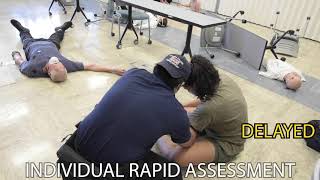
DELAYED (Yellow) - The victim has non-life-threatening injuries that need medical attention, but it may be delayed by a few hours.
MINOR (Green) - The victim is either uninjured, or has minor injuries that may need medical attention in the next few days "the walking wounded"
The colors correspond to triage tags, which are used by some agencies to indicate each victim's status, although physical tags are not necessary if patients can be physically sorted into different areas.
Responders arriving to the scene of a mass casualty incident may first loudly ask that any victims who are able to walk relocate to a certain area, thereby identifying the ambulatory, or walking wounded, patients. Responders then fan out to assess the non-ambulatory patients in the order closest to furthest away assessing all of the victims before treating any.
The only medical intervention used on adult patients during triage is an attempt to open the airway (however in some jurisdictions, first responders are also directed to apply tourniquets to control major hemorrhage during the initial triage phase). The only medical intervention used on pediatric patients is opening an airway and providing rescue breaths when indicated.
Step
Action
START Classification (Adults)
JumpSTART Classification (Children)
Find ambulatory patients
Call out to all victims in the area asking any who are ambulatory to come towards the response vehicles, or designated area.
MINOR (Green) Adults who arrive on their own power
MINOR (Green) Children who arrive on their own.
Infants and toddlers carried in by an adult should be further evaluated to determine Classification.
Assess Airway
If no respirations, perform maneuver to open the airway to determine if spontaneous respirations start.
DECEASED (Black) If no respirations following airway opening (Adults only)
If no respirations following airway in a child, check for peripheral pulse:
DECEASED (Black) no pulse.
If peripheral pulse, deliver 5 rescue breaths.
DECEASED (Black) no return of spontaneous breathing
IMMEDIATE (Red) return of spontaneous breathing
Assess Respiration
If patient is breathing spontaneously, count respiratory rate.
IMMEDIATE (Red) if RR >30
IMMEDIATE (Red) RR under 15 or over 45
Assess Perfusion
Check radial pulse and capillary refill.
(Apply tourniquet if indicated in your medical direction)
IMMEDIATE (Red) if radial pulse absent or capillary refill > 2 seconds
IMMEDIATE (Red) if unable to follow simple commands or ALOC
IMMEDIATE (Red) if age inappropriate difficulty with simple commands
Finish and MOVE ON
Confirm that airway, respiration, perfusion and mental status are all within triage values.
DELAYED (Yellow)
DELAYED (Yellow)
REMEMBER: No interventions or therapies are attempted on any patients until all patients have been evaluated and classified, except where indicated in the above algorithm.
Once classification is complete and reported back to the incident commander:
If possible with available resources, move IMMEDIATE (Red) patients to a single staging area accessible to ambulances where treatment personnel can more effectively tend to and monitor the most urgent patients and further prioritize patients for transport.
If more personnel are available, move DELAYED (Yellow) patients to a separate staging area where supportive care can be provided until more personnel become available.
Documentation
Documentation of triage
Triage documentation may change depending on the protocols for the EMS system during a mass casualty event. This may be a shortening of PCR documentation to only indicate patient's name, destination, triage designation, and potentially vital signs and treatments performed. This documentation is NOT performed by the triage team, it would be performed by providers at the staging areas.
Self Assessment
Self-assessment
Use the RPM-30-2-Can do mnemonic to drill classification criteria
The scene of an MCI will often contain unseen hazards. Maintaining situational awareness amongst many injured or potentially dead patients is difficult for every rescuer but safety remains a priority. Remember, every rescuer that is injured requires two more rescuers, one for themselves and another for their patients.
Nothing can truly prepare you for experiencing an MCI. In the event of a large-scale event, the saying "You do not rise to an occasion, instead you fall back to the level of your training" becomes doubly true. Practice is the only way you will be able to reliably and correctly triage patients in a hectic mass casualty incident.
An easy way to remember adult START criteria is "30-2-can do". If your patient is not able to walk and has less than 30 respirations per minute, less than 2 seconds for capillary refill, and is either alert or "can do" (follow) instructions, they are classified as a delayed patient.
Additional Resources
Although START and JumpSTART triage systems are common in California, there are other triage systems such as SALT. Be familiar with the triage system used in your area of operation.