Motivation and project description
Nineteen million Americans have significant vision loss. Over 70% are not employed full-time, and more than a quarter live below the poverty line. Globally, there are 36 million blind people, but less than half use white canes or more costly commercial sensory substitutions. The quality of life for visually impaired people is hampered by the resultant lack of independence. To help alleviate this challenge this study reports on the development of a low-cost (<$24), open-source navigational support system to allow people with the lost vision to solve the primary tasks of navigation, orientation, and obstacle detection to ensure their safety and mobility.
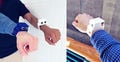
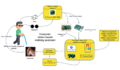
The proposed system can be largely digitally distributed manufactured. It conveys point-distance information by utilizing the natural active sensing approach and modulates measurements into haptic feedback with various vibration patterns within the distance range of 3 meters. The developed system allows people with the lost vision to solve the primary tasks of navigation, orientation, and obstacle detection (>20 cm stationary and moving up to 0.5 m/s to ensure their safety and mobility. Sighted blindfolded participants successfully demonstrated the device for eight primary everyday navigation and guidance tasks including indoor and outdoor navigation and avoiding collisions with other pedestrians.
Design process
The first version of Blind Person's Assistant was presented as a part of Open Source Appropriate Technology (OSAT) project for Dr. Joshua M. Pearce's course of "Open-source 3D printing" in 2018.
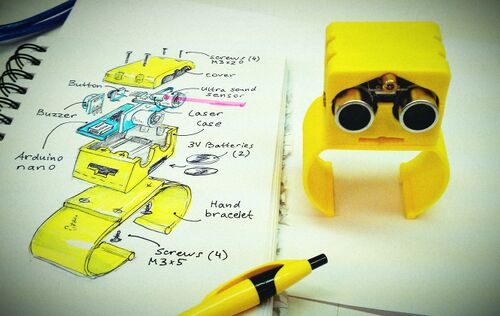
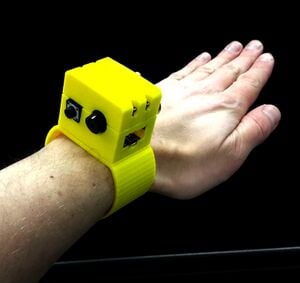
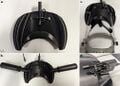
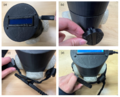
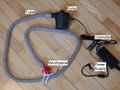
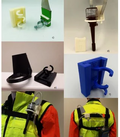
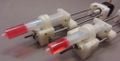
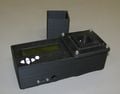
There were several iterations to improve the functionality and ergonomics, using different materials and forms for the design of the case. The electronic part was also significantly revised to maintain effective functionality with minimal dimensions. FFF 3D printing technology provides the best distribution and replication capability, while the flexible filament ensures a reliable assembly without metal parts, easily fits wrist without hurt, tightly fixes the sensor core and absorbs excessive vibration.
The preliminary testing of the device was determined to be a success based on all three participants being able to complete the eight tasks outlined in the methods section. All participants during the experiments noted the effectiveness of the haptic interface, the intuitiveness of learning and adaptation processes, and the usability of the device. The system produces fast response and allows a person to detect objects that are moving. It naturally complements primary sensory perception of a person and allows one to detect moving and static objects.
Future work is needed to further experimentation to obtain more data and perform a comprehensive analysis of the developed system performance. This will also allow us to improve the efficiency of its tactile feedback, since the alternation of patterns of high-frequency vibrations, low-frequency impulses and beats of different periodicity can significantly expand the range of sensory perception.
Conclusions
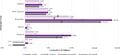
The developed low-cost (<$24 USD), open-source navigational support system allows people with the lost vision to solve the primary tasks of navigation, orientation, and obstacle detection (>20 cm stationary and moving up to 0.5 m/s within the distance range of up to 3 meters) to ensure their safety and mobility. The devices demonstrated intuitive haptic feedback, which becomes easier to use with short practice. It can be largely digitally manufactured as an independent device or as a complementary part to the available means of sensory augmentation (e.g. a white cane). The device operates in similar distance ranges as most of the observed commercial products, and it can be replicated by a person without high technical qualification. Since the prices for available commercial products vary from $100-800 USD, the cost savings ranged from a minimum of 76% to over 97%.