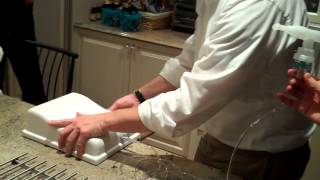
In remote areas and resource-limited settings, clinics may lack expensive, electric nebulizers to induce sputum samples for tuberculosis diagnosis and respiratory treatments.
We have developed two versions of the Human Powered Nebulizer. One is hand-cranked; the other is pedaled like a bicycle. The health care provider operates the HPN while the patient induces a sputum sample or receives treatment. This technology is inexpensive and portable, putting respiratory treatment and diagnostics in the hands of even the most remote clinics.
Demostration
Designed by
Designed by: The Human Powered Nebulizer Project at Marquette University.
Manufacturing: Milwaukee, Wisconsin, USA
When and where it was tested/implemented
The first clinical trial was conducted in South African in 2010, in conjunction with the London School of Hygiene and Tropical Medicine and the Desmond Tutu HIV Centre. Additional clinical and field trials are currently being conducted in Malawi and El Salvador.
Funding Source
Funding provided by the Marquette University College of Engineering Opus Fund, the Northwestern University Alumnae Foundation, and the National Collegiate Inventors and Innovators Alliance (a philanthropic competition). Generous in-kind support has been provided by Particle Technology Labs, the London School of Hygiene and Tropical Medicine, the Desmond Tutu HIV Centre, Cape Town, South Africa and the Milwaukee Institute of Art and Design.
Peer-reviewed publication
Kranzer K, Olson L, van Shaik N, et al. (2011.) Quality of induced sputum using a human-powered nebuliser in a mobile human immunodeficiency virus testing service in South Africa. Int J Tuberc Lung Dis 15(8):1078-81.
Other internally generated reports
Human Powered Nebulizer Project. (2010.) Human Powered Nebulizer Project NCIIA pitch.
Human Powered Nebulizer Project. (2010.) The HPN in Masiphumelele, South Africa.
Externally generated reports
National Collegiate Inventor & Innovator Alliance. (2010.) Top 3 March Madness for the Mind videos announced. Link available here.