Petri Mustonen' Aalto University, Department of Electronics and Nanoengineering
The polishing of copper foils is essential for high quality CVD graphene growth. The cold-rolling manufacturing process of these foils leave deep macro-sized striations on the foil surface, as well as numerous micro-sized defects. Generally these striations and defects are removed by using electrochemical polishing process. Even though this is easy to do manually, as the foil size is scaled up then the bending of the foils becomes a problem. The electrodes should be as straight as possible to ensure constant current density along the foil which is needed for smooth polishing process.
This project is meant to be used as a tool for keeping the foils straight as well as allow to change the distance of the electrodes easily. The model is made by OpenSCAD and is highly customizable.
NOTICE! You need to check the chemical stability of your printing material! I suggest starting with Polypropylene (PP) and Fluorinated Ethylene Propylene (FEP) and to check whether they work for you.
This project is the final project of the author for the L3999 course of Fall 2017.
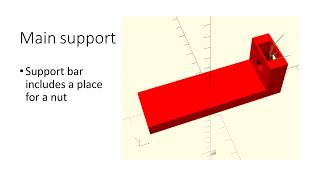
The entire structure is meant to be placed on top of a box in which the polishing process is done. The main support bar is merely a rectangular block on top of which is a slider. This slider is connected to a screw which is also attached to the main support bar, the slider is moved by rotating this screw. A secondary slider is pinned on one location of the support bar. Both sliders are connected to a frame. These frames have copper foil pinned in between them (a foil is pinned between two halves of the frame).
More detailed description in the video below.
37g of PLA and 8g of PP (frame and attachment pins) =~$1.5 Using these materials: https://web.archive.org/web/20210617213737/https://gizmodorks.com/polypropylene-3d-printer-filament/ ~$62.5/1kg and https://web.archive.org/web/20220603014826/https://lulzbot.com/store/polymaker-polylite-pla-filament $25/1kg. https://ecoreprap.com/filament/pla-filament/ $22/1kg
Numerous parameters are customizable, however, the most important ones are listed here:
NOTICE! Changes to SCREW LENGTH have to be done in the data-metric_cyl_head_bolts.scad file!
I would recommend that you first print the screw, nut and main slider to check that they all connect together well. The side of the nut which is towards the printing pad is possibly smaller and this might need fixing, I peeled small pieces off of the nut with a hobby knife until the screw went through well. I would recommend to do this and not to go for a larger nut as it is better if the seal is tight and the screw does not wobble. Regarding this, it is also better that the sphere on the end of the screw is tightly in the slot on the main slider. If this wobbles it can be hard to keep the foil completely vertical. If the nut is too loosely in its slot (it moves around), then you need to change the "nut_scaling" parameter in the "Fine tuning" parameters section of "support_and_slider.scad" file.
The attachment pieces (pins and the frame attachment) can have printing issues due to the small size, warping can be expected. For PLA printing I used wood glue to get better adhesion on the printing pad. A raft or a brim can be used as well, but I found out that the complete removal of these structures can be an issue. This issue might arise with the frames as well, but for me it didn't happen enough for it to be a problem.
It can be hard to properly pin the second slider to the main support with the slider pins. If this is the case, then you can either try to make the fit better or you can use a thin PLA piece (I used a piece of a frame) and push it in between the slider and the support bar. This will probably hold the slider in place much better.


| License | CC-BY-SA-3.0 |
|---|---|
| Cite as | Mustonp1 (2017–2025). "Electrochemical polishing support for copper foils". Appropedia. Retrieved October 3, 2026. |