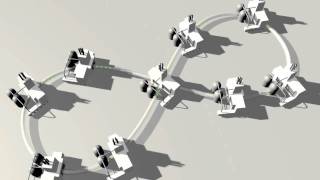
"An eco-industrial park (EIP) or estate is a community of manufacturing and service businesses located together on a common property. Member businesses seek enhanced environmental, economic, and social performance through collaboration in managing environmental and resource issues. By working together, the community of businesses seeks a collective benefit that is greater than the sum of individual benefits each company would realize by only optimizing its individual performance."
"The goal of an EIP is to improve the economic performance of the participating companies while minimizing their environmental impacts. Components of this approach include green design of park infrastructure and plants (new or retrofitted); cleaner production, pollution prevention; energy efficiency; and inter-company partnering. An EIP also seeks benefits for neighboring communities to assure that the net impact of its development is positive."
(Lowe, Ernest. 2004. Defining Eco-Industrial Parks: the Global Context and China. Report prepared for the Policy Research Center for Environment and Economy, State Environmental Protection Administration, China)
Overview
In an EIP, the use of energy and materials is optimized in such a way that the output of one process is the input into another ("industrial ecosystem"). These arrangements may result in cost savings and waste reduction. The design of the industrial infrastructure attempts to maximize economic and environmental efficiencies. Businesses cooperate with each other and with the local community in an attempt to reduce waste and pollution, efficiently share resources (such as information, materials, water, energy, infrastructure, and natural resources), and help achieve sustainable development, with the intention of increasing economic gains and improving environmental quality. An EIP may also be planned, designed, and built in such a way that it makes it easier for businesses to co-operate, and that results in a more financially sound, environmentally friendly project for the developer. An example of this is the designed eco-industrial park centered around photovoltaic devices discussed here. When there is a strong agricultural component, the name Agro-Eco-Industrial Park is sometimes used, emphasizing the agricultural component with food, fuel and fiber as products.
Benefits of EIPs include:
monetary benefits to companies (lower production costs / bargain prices, lower energy consumption, less transportation, less waste)
environmental benefits (less demand on natural resources, less waste in all forms, transportation via pipes instead of trucks)
societal benefits (jobs, cheap heating, better air quality, better health)
Industrial symbiosis (IS) is the most familiar subject of research and application in industrial ecology. The essence of this approach is a collaboration among industrial plants and utilities to increase the efficiency of resource use by creating a system for trading material, energy, and water by-products ("wastes"). An authoritative definition of IS broadens the field to include sharing of utility infrastructure and joint procurement of common services. IS is also referred to as: by-product exchange, by-product synergy, industrial ecosystem, industrial metabolism, green twinning, and zero emissions network. - these all refer to similar ideas. An eco-industrial park is a more comprehensive framework for development.
This subject is of interest to energy engineers and managers because the primary goal of IS projects is to achieve higher efficiency in using resources in order to meet the challenge of increasing costs and declining stocks of major commodities. By reusing otherwise unmarketed by-products through a network of exchanges, participants increase the efficiency of energy generation and capture energy embedded in material and water outputs. They also reduce costs of disposal, may receive revenues for the by-products, and reduce net greenhouse gas emissions. A further benefit to the economy is reduced public costs of disposal.
Industrial Symbiosis Poster
System Design
There seem to be two different basic approaches to establishing an EIP: the self-organizing and the engineered system. The self-organizing system is characterized by facilitated organic growth (without any overall engineering design) of connections between companies - the system gradually develops like an organism. In contrast, the engineered system approach relies on detailed analysis of data as well as local / regional resource and energy flows to find possibilities to maximize efficiency in interaction.
Design options include site design, park infrastructure, individual facilities and shared support services. System components include natural systems (e.g. solar, wind, biomass, water resources etc.), energy (e.g. steam), material flows (e.g. co-locating brewery + mushroom farm + pig farm), water flows (different grades of water, e.g. processed/used water), management and support services (e.g. training center, cafeteria, day care center, offices, transportation logistics).
Possible Tenants
The following list was excerpted with modifications from this page, which contains a lot of specific examples and business models. Tenants on an agro-eco-industrial estate may include:
Suppliers of equipment, energy, materials, and services to farmers (field equipment, equipment for monitoring of nutrients, co-generation of energy for food processing, biomass by-products, ethanol fermentation, bioenergy crops, Integrated Pest Management services, consulting and training firms, agricultural extension agencies,...)
Food processing and distribution firms (distribution center for fruits and vegetables, community supported agriculture, dairy processing, meat/fish/poultry processing)
Firms utilizing by-products from any part of the system (energy generators, manufacturers using biomass by-products, ethanol/methane, animal feed processors, greenhouses and aquaculture ponds, composting yard)
Intensive food production located in or near an agro-estate (landscaping, greenhouses and aquaculture ponds, integrated brewery, etc.)
Other potential recruitment targets (manufacturers using primary biomaterials such as hemp or bamboo, etc.; agritourism)
Potential Difficulties / Problems
potential as an obstacle to further evolution in technologies (e.g. continued reliance on toxic materials or obsolete technologies just because inter-company networking permits it)
complex inter-firm dependencies (stability of the park as a whole may be at risk if a crucial element is lost)
risk of higher development costs (e.g. from the design process, site preparation, infrastructure features, construction processes, aspects of building design)
with public-private partnerships: possibility of too much dependence upon public agencies and too little involvement of private sector players
risk of overstating the case: ecological benefits and benefits of closing material flow loops may be limited