| Type | Waste management project |
|---|---|
| Authors | Anamika Tanvi Gulati Anna Spitzer Jasmine Phillips |
| Location | Delhi, India |
| Status | Deployed |
| Years | 2018 |
This page explores the community engagement subgroup for team Daula. We aimed to create sustainable social entrepreneurship opportunities, spread awareness about environmental issues and solutions, and encourage a sustainable community in terms of solid waste management. We strongly focused on working alongside community members and having their input and participation along the way.
Rural Youth Volunteers in India was a paired program between Lady Irwin College, New Delhi students and Cal Poly Humboldt, California students. The program took place between May-August 2018. Our paired teams divided between two villages: Dula, which focused on waste management, and Taveleghari which focused on water. Within each village, we split into two subgroups: product team and community engagement team.
We began the first two weeks by building rapport with community members and assessing what was already working well within the community. We also developed criteria to guide what we would include in our community engagement activities. These activities included games, songs, street plays, and school activities. To get the most of these activities, we continuously prototyped and improved.
Our findings were that hands-on community engagement techniques seemed to be most impactful in spreading awareness about waste management. Many households upcycle on a personal household scale, but more for saving money than for saving the environment. We witnessed some behavior change in terms of refusing plastic bags and finding use for waste, such as vermicompost. The next steps for Daula's waste management initiative will be carried forth by the core team members that worked with us daily. In the future, we hope to see a more sustainable Daula driven by the integrity of its own community members.
(Describe the background of the project. Make sure to cover who, what, why, when and where. This is not the problem statement. It is the background that readers should understand before the problem. Remember that the reader does not know anything about the project, except what you covered in the abstract above.)
We are "Rural Youth Volunteers in India" which is a paired program between Lady Irwin College, University of Delhi and Cal Poly Humboldt, California. Our project takes place in villages of Daula, and Tavelagardhi in Uttar Pradesh, India. We are collaborating with Environment and Social Research Organization (ESRO) and a local partner in Daula, Grameen evam Pariyavaran Vikas Sansthan (GPVS). We are supported by the U.S. Mission to India. The Daula team includes four students from Cal Poly Humboldt and four students from Lady Irwin College who work together for 10 weeks starting in June 2018 and continuing into August 2018.
In the Daula team, we have two subgroups. The product subteam has the task of creating upcycled products out of waste material that can be recreated by community members and has the potential to be sold within the community. The community engagement subteam has the task of meeting, teaching, and involving people in the community with the project.
Our team strives to create sustainable social entrepreneurship opportunities, initiate upcycling of waste within the community, promote sustainability of the project over subsequent years, spread awareness about environmental issues and solutions, with a focus on waste management, and to use only waste that already exists in the community and not to generate more waste in the process. The over compassing aim of this project is to encourage a sustainable community in terms of solid waste management by the technique of upcycling waste into something functional and resourceful. Throughout this project, we work closely with community members and seek their participation in bettering their economic and environmental well-being.
Engagement team has used various methods to collect information from the community. The process of collecting information initiates with rapport formation which helps to build a good relationship with community members. This process ensures trust and hence lead to mutual learning. Engagement team and product team were synchronized with each other therefore the responses from the community were analysed and shared with rest of the team for efficient and effective results.
Describe your various processes for collecting information. Summarize the results. Include some pictures. Include some specific demonstrative anecdotes.
The team had interviewed various people of the community in order to understand the dimensions of the community. It was used as a tool to gather information from her community.
Farmers: Cash crop, i.e. sugarcane was majorly growing by the farmers. They use urea fertilizer, irrespective of the fact that it is harmful to humans. There are about two to three vermicompost units in and around the village. All the vermicompost produced in these units is exported to other states of India as there is no demand in their own state.
Women: Women in the community have the skill and the confidence to upcycle products but whenever asked if they would like to come to the centre for a weekly meeting or training session, they would either answer; yes and didn't appear or; they had to ask for the permission from their husband.
School Teachers: The engagement team interviewed around nine schools teachers and/or principal. School teachers showed great interest. They were willing to contribute their maximum for the project. The major finding from the interview was that the teachers wanted give exploration to their students about different issues.
During the time in the community, we utilized a few community meetings to interact and build rapport with the community members. A few community meetings that were utilized for this purpose were:
Farmers:Farmers in the community were engaged in producing cash crops, i.e. sugarcane. According to farmers, growing cash crop was a compulsion for them as they have responsibilities of their families. It is the source of their livelihood. They use urea fertilizer, irrespective of the fact that it is harmful to humans. There are about two to three vermicompost units in and around the village. All the vermicompost produced in these units is exported to other states of India as there is no demand in their own state. The farmers had knowledge about the ill factor of the fertiliser but they still use it.
Religious community meeting: They main motive of the religious community meeting was to engage with the community. The place as well as activities to be done in the meeting was decided by the community women. The meeting was followed by singing Religious songs and dancing. The result of the meeting was that the engagement team gained the trust of the community members especially; women.
School Visit: Children are the main source to spread the words around the village, therefore we had a meeting with the school teachers of the various school in the community. Majorly; the schools were interested to be a part of the cause. After having the meeting with the nine schools, the team came to a conclusion to engage two schools in the project. the schools were decided on following bases, the relation of school with the local NGOs, location, type of school(private or government) and the enthusiasm of the principal of the school.
Key stakeholders of the community:The important key stakeholders of the community were Hindu as well as Muslim priest, principal of the school, panchayat, opinion leaders, local government representatives, various organizations and people working for social causes within the community. As a result of the meeting, various people as well as the organisation came together or share their ideas as well as experience with us. All this leads towards the success of the project.
Incorporated two types of observation approach, i.e. participatory and non-participatory observation. It helped to gather really important and latent sights of the community. Various non-verbal clues of the community members were taken into consideration while conducting various interviews, meetings, home visits, etc. The team observed the following details:
Occupation: They majorly depend on the primary sector for income generation. Farming is their main occupation. The major crops produced are sugarcane because it is a cash crop. They use urea fertilizer, irrespective of the fact that it is harmful to humans. There are about two to three vermicompost units in and around the village. All the vermicompost produced in these units is exported to other states of India as there is no demand in their own state. Therefore, the team planned to conduct were meetings and sessions where the importance of organic farming has been told. The key speakers were called to address the farmers to extend their knowledge about the making of these compost out of waste materials available in their environment.
Religion: There were two religious groups in the community, i.e. Hindu and Muslim. The geographical area was also divided according. There were sperate Muslims schools in the community. Thus, the team came with few ideas, i.e. to take the Pandit Ji(Hindu priest) and Maulana Ji(Muslim Priest) into confidant as they the influential leaders. Contend were also kept religious neutral to increase the reach as the impact of it.
Gender Gap: There were different classrooms for boys and girls in the school. Under no circumstances, two genders were allowed to communicate or even participate together. The major observation was the existence of deep-rooted patriarchy in the community. Even the female political leader was voiceless and under the veil in front of elder male members of the community. Considering the above observation, the team conducted a few of the meeting with both of the genders separately so that women can also share their opinion with freedom.
Indigenous Knowledge structure: The members of the community have their own indigenous knowledge structure. They produce their own products from waste materials like straws, bangles, glasses, C.D., threads, sack, plastic bags and bottles, waste clothes, cardboard boxes, dow dunk, etc. It was a mutual learning process.
Sustainability:As a result of team efforts and a new group of youth individual emerges from the community named as Plastic Free Knights. They become the core team who were responsible for the long-life of the project.
I think we might skip this just this time... feel free to wait until I arrive to complete the literature review subsection. Introduce the literature review briefly and then use heading and subheadings for topics. This should focus on information… NO PLAGIARISM![1] Copy and paste from this Practivistas India/literature review template.
The objectives of this project are:
(Feel free to include specification and considerations here, or make subsections for them.)
The criteria, constraints and weights were discussed within the engagement team. The table below includes the principles or standards which were followed during the project:
| Criteria | Constraints | Weight (0-10) |
|---|---|---|
| Accessibility | Accessible to a vast majority of community members, independent of social stratification (i.e., socioeconomic status, religion, caste, gender) | 8 |
| Environmental sustainability | Atleast do not create harmful impact to the environment and atmost mitigate the risk associated to waste management. | 9 |
| Cost | Costs to complete the reasonability within the budget. All the events or activity should incur cost as low as possible. | 7 |
| Appropriateness | Atleast content should be understandable by the heterogeneous audience. Doesn't offend the sentiments of any community. | 10 |
| Impact | Atleast impact while it is happening at the moment and atmost bring behaviour change among the community members. | 9 |
| Safety | The activity or event should be safe for the team as well as people of the community. | 10 |
| Desirability | People find it useful and atmost it should initiate participation. | 9 |
Describe your various processes for prototyping for function and desire. You will need to make some executive decisions on what to include and what not to include. It is important that the major prototyping tracks are described, including the ones that ended in 'failure'.
The aim of the street play was to engage a wide audience in a fun dialogue about waste management. It was designed to spread awareness about the long term effects of plastic in the environment. The script was built with members of the community to ensure the local dialect was used. The goal of this prototype was to test the play's accessibility, safety, and appropriateness. In the first performance prototype, we performed at the inter-college where we recruited the participants. We learned how to properly stage the performers for a majority of the audience to see their faces. Our second performance was on a street by the community center in which we work. Here, we had a large crowd, and confirmed street plays are a good way to reach the general public. It also informed us we need to secure a safe place out of the street beforehand. By the third performance, the street play was no longer a prototype but a final version.
We held many meeting in the community center, which were dual purpose
Describe the results of each of the prototypes.
For the behaviour change of the children, we planned the lesson plans and disseminated them to the students from class (3-8)th. The lesson plans included compost, waste management, food web and seed germination and also we taught the songs created by the core team.
We held an environment education fair in which we showcased the products like plastic stringers, tiles, grocery bags, clipboards, pens and played some edutainment games like compost toss, floor games, showcased flipbook and had a photo-booth for the community people.
| Date | Description |
|---|---|
| May 28th-30th, 2018 | Arrived in New Delhi, India |
| May 30th-June 3rd, 2018 | American Center and Lady Irwin College Welcome Presentation | Travel and Welcome Ceremony: Baraut, Tavelagarhi and Daula |
| June 4th-10th, 2018 | Community Engagement and Interviews | Empathy/Rapport/Ideate | Tree Plantation | Songs with Children in Communtiy |
| June 11th, 2018 | Create sub-teams to start narrowing down project ideas | Meet with community members to focus in on our project | Class meditation to center ourselves |
| June 12th, 2018 | Men community meeting to get feedback on possible products | Play Kho-Kho game with children | |
| June 13th, 2018 | Select product to prototype | Plan prototyping | Plan testing of prototype | Start prototype with stringer | Meeting with Krishan Pal ji to discuss compost | Meeting with government officials | Site visit and meeting with Satpal ji at his vermicompost site. |
| June 14th, 2018 | Half Day | Planning for the women community meeting | |
| June 15th, 2018 | Off Day |
| June 16th, 2018 | Eid Day| Solar Panel Installation |
| June 17th, 2018 | Start prototyping& Test prototyping | Community walk | Meet Satpal ji (vermicompost farmer) |
| June 18th, 2018 | Meeting with community women | Watch waste management documentary |
| June 19th, 2018 | Discuss compost product ideas | Compost for community engagement |
| June 20th, 2018 | Pick exhibition date | Discuss market and what to prototype | Lady Irwin College professors visit |
| June 21st, 2018 | Yoga day | Class |
| June 22nd, 2018 | Off Day |
| June 23rd, 2018 | Visit primary school |
| June 24th, 2018 | Finalize products for community market |
| June 25th, 2018 | Late Start| Showcase products in community market |
| June 26th, 2018 | Debrief from market| Game day at community center with children | Taught children songs |
| June 27th, 2018 | Prepare for vermicompost training | Vermicompost training advertisement | Split teams | Prep for temple |
| June 28th, 2018 | Worked on Calendar as the whole team| Meeting with NABARD| Half Day |
| June 29th, 2018 | Off Day |
| June 30th, 2018 | Work on vermicompost workshop | Go out in community and advertise project | Work on street play script | Work on primary school activities | Call primary school principal and verify activity dates |
| July 1st, 2018 | Work on primary school activities | Work on street play script | Prepare for vermicompost training | Call interested vermicompost people | Prepare announcement for plastic collection | Visit vermicompost farmer |
| July 2nd, 2018 | Vermicompost training | Work on script for street play | Finish primary school activity #1 |
| July 3rd, 2018 | Work on script for street play | Visit temple and engage with community | Work on primary school activities | Visit 7 schools in community | Prototype announcement for plastic bag collection |
| July 4th, 2018 | Work on script for street play | Work on primary school activities | Prototype seed germination for primary school activity 1 |
| July 5th, 2018 | Product: Tree planting | Practice street play | Work on environmental education lesson plans |
| July 6th to 8th, 2018 | Off Days |
| July 9th, 2018 | Practice street play | Write announcement for fair | Visit possible fair locations | Plan for education fair | Visit primary school |
| July 10th, 2018 | Call primary school principal | Prepare primary school activity logistics #1 | Work on fair poster/finish | Plan fair | Pen making with community members at community center |
| July 11th, 2018 | Auditions at intercollege for street play | Primary school activity 1- seed germination | Work on plastic collection and fair announcements |
| July 12th, 2018 | Mid program Debriefing in Delhi |
| July 13th, 2018 | Debrief from primary school activity | Primary school activity- Parts of a Tree | Perform street play | Distribute education fair posters | Meet Adarsh Intercollege principal about volunteers for education fair |
| July 14th, 2018 | Adarsh Inter-college assembly- announce fair and ask for volunteers | Primary school activity - waste and parts of a tree | Announce fair by rickshaw |
| July 15th, 2018 | Announce fair (e-rickshaw and community leaders) | Call people to invite to fair | Create banner | Modify seed lesson for 6th class activity |
| July 16th, 2018 | Plan american center presentation | Prepare 6th class activity logistics for lesson | Write pledge poster | Practice street play |
| July 17th, 2018 | Day Off |
| July 18th, 2018 | Debrief from primary school activity | Primary school activity -compost | Street play rehearsal in Adarsh Inter college | Call satpal ji about fair, compost, worms | Finalize pledge banner and videos for fair | Work on Presentation for the American Center Debrief/Visit Create fair layout| Fair logistics |
| July 19th, 2018 | <no>
E-rickshaw announcement for fair | Debrief from primary school activity | Visit primary school | Performance of street play | Go through Checklist for the Fair </nowiki> |
| July 20th, 2018 | E-rickshaw announcement for education fair | American Center visit | School engagement showcase of posters, songs and street play | Meeting with core community members |
| July 21st, 2018 | Educational Fair |
| July 22nd, 2018 | Assessment Fair |
| July 23rd, 2018 | Education fair in Tavelagarhi (Daula team joins them) |
| July 24th, 2018 | Debrief Tavelargarhi | Visit primary school |
| July 25th, 2018 | Street play rehearsal at Intercollege | Primary school activity- Web of Life |
| July 26th, 2018 | OFF |
| July 27th, 2018 | OFF |
| July 28th, 2018 | Plastic mold workshop | Identify Key Community members | Meeting with core team members to discuss second fair |
| July 29th, 2018 | Prepare for primary school and inter-college | Discuss Appropedia and assign responsibilities |
| July 30th, 2018 | Teach plastic song at primary school | Computer literacy workshop for core team members - Microsoft Office (Word, Powerpoint, Excel) |Documentation | Appropedia |
| July 31st, 2018 | Computer literacy workshop for core team members- Google tools | Poster making and street play practice at intercollege |
| August 1st, 2018 | |
| August 2nd, 2018 | Day Off |
| August 3rd | Appropedia first draft due | Rally & fair preparation | August 4th, 2018 | <tt><nowiki> PFK's Rally in afternoon | Visit core team member's families |
| August 5th, 2018 | PFK's Environmental Fair |
| August 6th, 2018 | Clean up |
(Describe your tangible findings.)
Throughout our time in the village, Daula, we have merely skimmed the surface in understanding the dynamics of this community. When we first came to the village we found there was already upcycling happening on an individual level in many households. We found out the village already had many entrepreneurs and a large population of farmers. Engaging in the community has brought us closer to a variety of people from different casts, religions, and age groups. When a person is involved in the creation of a product, a song, or a street play, it is more impactful on influencing behavior change. This behavior change has been obvious in the core team members we have worked with throughout this project. During our regular visits to two schools in Daula we have made connections through the education of children about the environment and the importance of waste management. Through environmental education lessons, songs about upcycling and a street play about waste reduction children have been key players in spreading a message across their community about the importance of waste management.
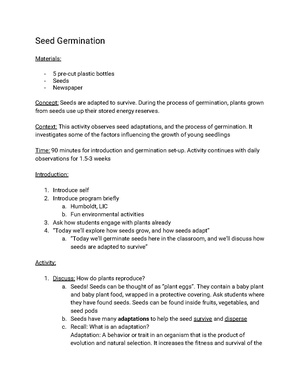
The team found the lessons taught at the school to be engaging, relevant, educational, and fun for the primary school children. One of the lessons taught to 5th, 6th, and 7th class students was on seed germination. Below is a copy of the lesson plan used.

Although, we tried to cover the whole community, but it was not possible for us to engage with the entire village with a population of 20,000 with heterogeneous people.
Throughout our project, we kept in mind our criterion of sustainability and impact. We wanted our community engagement to not only be impactful as it took place, but residual after we leave. We took steps to ensure our project's ideas will live on and evolve. Some of these steps included:
Furthermore, our project will continue with the help of our core team members. They formed the group "Mission Clean Daula", comprised of about 15 young men. Mission Clean Daula plans to continue engaging with the community to spread awareness about waste management. They've worked alongside us in all our endeavors and have picked up many useful skills along the way. These include interview skills, project management, and computer literacy skills. Goals of theirs so far include weekly volunteer clean-ups, and having personal conversation with shopkeepers about the use of plastic bags. We are confident they will keep the community's drive to improve their waste management sparked.
Daula village's engagement team consists of four members:
| License | CC-BY-SA-3.0 |
|---|---|
| Organizations | Lady Irwin College, Rural Youth Volunteers in India, Cal Poly Humboldt |
| Cite as | Jasmine phillips, Lonny, Tanvi gulati, Anamika, A.e.s (2018–2026). "Daula waste community engagement 2018". Appropedia. Retrieved October 1, 2026. |