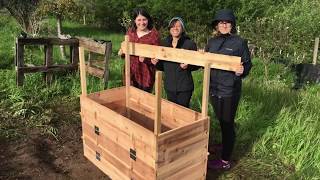
Cal Poly Humboldt engineering students working with community groups to design, build and plant a system for growing potatoes above ground at Abuelita's Demonstration Garden in Eureka, CA. The structure uses materials sourced and/or donated from local businesses and partners in attempt to encourage communities to become more self-sufficient by growing their own food. The team put on a follow-up workshop for community members that consisted of a miniature replica of the permanent structure showing that food can be produced independently and at home, even with a limited amount of space.
Background
During the spring semester of 2018, students from the Engineering 305 Appropriate Technology class at Cal Poly Humboldt implemented a vertical food growing operation in Eureka, California. The project is in conjunction with Cooperation Humboldt and Redwood Community Action Agency as a directive to increase community access to local and healthful food. The mission statements of these local organizations align with the values that we hold as active community members.
"Cooperation Humboldt exists to help develop a solidarity economy across the North Coast. We identify, support and nurture cooperative economic efforts that help people meet their needs without exploiting or oppressing anyone, without being exploited or oppressed by anyone, and without destroying Mother Earth."
"[RCAA's] long-term goal is to develop programs through which people can become self-sufficient and empowered to improve their own lives. The primary mission of this nationwide movement is to "eliminate the paradox of poverty in the midst of plenty."
With these organizations, the team decided to address the food access barriers that many face in our community. The project provides an opportunity for those who do not have access to affordable food and do not have the yard space to grow produce in the earth to remedy the disconnectedness of our urban food complex.
Problem Statement
The objective of this project is to increase community access to local, organically grown food. The vertical garden has the opportunity to reduce the pressing need for fresh produce in the area as well as encourage self-provisioning and limiting dependence on industrialized agriculture. The project consists of two components. The first is a 4'x2'x2.5' potato tower built at Abuelita's Garden in Eureka, to contribute to the food production that is donated amongst recovery centers and shelters in the community. The second portion of the project is to imitate the same design but make them 2'x2'x2.5' and portable. The construction of these were during a community workshop to provide direct access to fresh foods and show that food can be grown in small spaces and temporary living situations or even on a budget.
Project Evaluation Criteria
The following criteria will be used to assess the success of the potato tower located at Abuelita's Garden in Eureka, California as well as the structures designed for the workshop. These criteria were selected based on the goals identified by the students and approved by the partnering organizations, Cooperation Humboldt and Redwood Coast Action Authority (RCAA). The scale (1-10) represents the importance level of meeting the constraint of each listed criteria. Although many efforts were made to source reclaimed, recycled, or salvaged components, we found the quality relevant to lifespan expectation, cost effectiveness and availability of such materials to be extremely limiting.
Criteria
Constraints
Weight (1-10)
Building Materials
More than 75% of the materials are upcycled or salvaged sourced
10
Seasonal Production for permanent tower
More than 100 pounds of potatoes
5
Seasonal Production for workshop towers
More than 35 pounds of potatoes
5
Maintenance
Less than 2 hours per month
8
Environmental Justice
Seeds and/or plant starters are locally sourced
7
Public Accessibility
Accessible 24 hours a day
10
Distribution
More than 80% of produce goes to service organizations
9
Literature Review
The students consulted outside experts and researched prevalant topics in order to assess which construction materials would be appropriate for Eureka, CA and final usage of the structure. The following provides brief summaries or key pieces of information from each topic that the students took into consideration when deciding the most effective and long-lasting materials to optimize potato growth in Eureka.
WOOD
The Vegetable Gardener's Book of Building Projects is a valuable resource containing designs and instructions for a variety of wooden structures to be used in a garden. Designs are provided for planters, raised beds, storage for tools and harvesting apparatus. Several of the projects would be good candidates for upcycled materials.[1]
Redwood
Redwood is moderately lightweight, strong, stiff and hard. "The wood is easy to work, generally straight grained, and shrinks and swells comparatively little. Heartwood from second growth trees generally has low to moderate decay resistance."[2]
Redwood has a natural resistance to insects, rot and moisture. Because it is a softwood, it is easy to work with and has a smooth appearance.[3]
Cedar
Lumber of Cedar is accessible and affordable. Cedar is resistant to termites and other insects as well as holding a resistance to rot and water damage.
Juniper
Juniper lumber is resistant to decay, and fungal and termite attacks. Due to these features, Juniper is long lasting and environmentally friendly.[4]
Moisture control of wood
"Moisture control is necessary to avoid moisture-related problems with building energy performance, building maintenance and durability, and human comfort and health. Moisture degradation is the largest factor limiting the useful life of buildings and can be visible or invisible. Invisible degradation includes the degradation of thermal resistance of building materials and the decrease in strength and stiffness of some materials. Visible degradation may be in the form of (a) mold and mildew, (b) decay of wood-based materials, (c) spalling caused by freeze-thaw cycles, (d) hydration of plastic materials, (e) corrosion of metals, (f) damage caused by expansion of materials from moisture, and (g) decline of visual appearance. High moisture levels can lead to mold spores in the air."[5]
Moisture Control Strategies
"Strategies to control moisture accumulation fall into two general categories: (1) minimize moisture entry into the building envelope and (2) remove moisture from the building envelope. It is not possible to prevent moisture migration completely; therefore, construction should include drainage, ventilation, and removal by capillary suction, or other provisions to carry away unwanted water."[6]
Structure Failures
"Structural failures caused by decay of wood are rare but have occured. Decay generally requires a wood moisture content equal to or greater than fiber saturation."[7]
METAL
Nickel Silver
A fairly easy to work with metal but in order to hamer and chase it it first needs to be annealed and then slowly cooled.
Aluminum-copper
Tough and resistant to chemical action but overall not very strong.
Aluminum-silicon
It is majorly aluminum and about 13% silicon. It is strong and tough with a good resistance to chemical attack.
Iron
It is the cheapest of all metals and most commonly used. If warmed to high temperatures it can be bent, stretched and shaped.
Tin
It is a silver-white metal, a little harder than lead. It is not very strong but it is ductile and pliable. It has a low melting point so it is often used as a soldering agent.[8]
CLIMATE
"According to the Holdridge life zones system of bioclimatic classification Eureka, California is situated in or near the cool temperate moist forest biome." With it's "warm mediterranean/ dry-summer subtropical climate"[9]Eureka gets an average of 3.35 inches of rain a month with most of it coming from the winter months.[10]The temperature ranges an average 51 degrees fahrenheit. Although the area gets what seems to be little to no sun it is actually sunny 48.3% of daylight hours the rest of daylight hours are either cloudy, with shade or low sun intensity. On average the midday sun over the horizon is 49.6 degrees fahrenheit.[11]
PLANTS and SOIL
Humgardens.com is a locally driven online resource for gardeners along the north coast. Providing access to weather information, webcams, and gardening information ranging from lawn care and rose maintenance to vegetable gardening. The site includes information on soil health and plant food, as well as a detailed calendar depicting how to care for different types of plants, what to expect for rainfall, and the varying sun angles for the area.[12]
Fruits of the Humboldt Bay is a locally developed guide to growing successful fruit plants in Humboldt's unique climate. The guide is a compilation of "collective wisdom" from several contributors including local farmers, professional orchardists, and indigenous wildcrafters. The intention of this guide is to provide a collection of local ecological knowledge so that we can produce nutritious foods in abundance and experience for sharing amongst the community.[13]
"Soil health is the capacity of soil to function as a vital living system, within ecosystem and land-use boundaries, to sustain plant and animal productivity, maintain or enhance water and air quality, and promote plant and animal health. Anthropogenic reductions in soil health, and of individual components of soil quality, are a pressing ecological concern."
"Soil health is worth quantifying because soils and their biota provide ecosystems functions that benefit humans. These ecosystem services can be of considerable value[15] and include soil functions of storing and releasing water, decomposing plant and animal residues, transforming and recycling nutrients, sequestering and detoxifying organic toxicants, and promoting plant health by suppressing plant-pathogenic microbes and phytophagous fauna."
DRIP IRRIGATION
Advantages
Reduces runoff
Water savings since less is evaporated
Fertilizers can be injected into the irrigation
Limits weed growth because of limited soil surface is wetted
Low water application rates improve water penetration on problem soils
Disadvantages
Wildlife can easily damage pipelines
Emitter clogging- can be hard to detect before crop damage occurs.
"In some areas, excess salts accumulate at the soil surface and toward fringes of the wetted soil. Rain may leach harmful amounts of surface salts into the root zone; drip irrigation should continue during the rain to prevent this problem."[16]
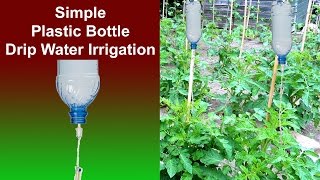
DIY Plastic Bottle Slow Drip System
Prototyping
The following are the first ideas and design prototypes the team came up with.
[OPTION A]: This potential design represents the general layout if we were to make an additional L shape pallet structure opposite to the existing structure. The new L shape will be about the same height and size of the other pallets. The tall "Solo" boxes adjacent to the pallet represent a vertical greenhouse using reclaimed windows (4-8 depending on width), supported by reclaimed wood.
[OPTION B]: This design incorporates similar structures but adding a diamond-shaped, vertical garden in the center. The taller "Solo" boxes, that match the direction of the existing pallets, would be a vertical greenhouse. The attached boxes are another set of pallets that would mirror the existing L shape. The middle box would be the centerpiece planter.
[OPTION C]: This is the design of what the permanent structure ended up being. The size did change to be 4' x 2' x 2.5'. The students incorporated hinged boards on both sides of the permanent structure to facilitate the harvesting process. The workshop towers were the same design just smaller at 2' x 2'x 2.5'. The small towers had two hinged doors on the front side only. All of the potato tower had small wooden latches to secure the hinged boards.
Overall design that provides a tentative placement structure of Option A.
Overall design that provides a tentative placement structure of Option B.
Sketch for Option C.
Construction
The potato tower at Abuelita's Demonstration Garden is constructed on 2x2s buried in the ground. The workshop will include a plywood "floor" on each tower so that it may be moved, or grown on a non-soil surface such as a patio. Cedar was chosen for the project as it is the standard wood for garden beds due to rot-resistance and lifespan. Redwood would have been an equally good choice, but is far more expensive.
After clearing a space large enough for the design, we measured and planned our corners, digging holes for the four 2x2s.
The team checked to see if the spot was level, to prevent our above-ground garden from sliding or shifting down the existing slope. Once the corner posts were buried and the holes filled, the team mocked up the box with the cut boards to test height and accessibility for harvesting.
Seeing the box at its true height was a determining factor for lowering the overall height of the design. At three or four feet tall, the team thought too much sunlight would be blocked for young plants to thrive. Additionally, the volume of soil inside a 4'x4'x4' potato tower would have caused immense pressure making it difficult to manage.
With the lowest level of boards in place, the team could level them and begin attaching them to the posts.
For the fold-down slats, the team measured the sides to match the posts for structure, and cut so that only the middle portion of the board would move when the turning latches are opened. After the hinges were attached, and each wooden latch was pre-drilled, the team attached them and tested our design.
To finish off the box, sharp points from any screws sticking through the boards were ground off for user safety:)
Timeline
The following is a timeline for the completion of the vertical garden project as well as the workshop.
TASK
FINISH DATE (Projected)
FINISH DATE (Actual)
Protoytype Demo
March 4/March 11
March 4/March 11
Compare costs/design of potential (available) materials
Mid March
March 19
Purchase materials
Early April
April 10-13
Build Structure
Mid April
April 14-15
Plant Gardens/Workshop
April mid
May 5
Final Update to Appropedia Page
May 1
May 8
Final Project Report Due
May 1
May 1
Final Presentation
May 8
May 8
Budget
The following shows the actual costs of the project materials. Fortunately Cooperation Humboldt provided a generous budget of $300. Although many efforts were made to source reclaimed/recycled/salvaged components, we found the quality, cost effectiveness and availability of such materials to be extremely limiting.
Material
Source
Cost ($)
Total ($)
Soil
Northcoast Horticulture Supply
donated
0.00
Potato Starts
RCAA
donated
0.00
Hardware
Ace Hardware
66.52
66.52
Hardware
SCRAP
5.45
5.45
Wood/Lumber
Resale Lumber Products
173.52
173.52
Total Cost
$245.49
Operation
Steps:
Fill the lowest 6" with soil, plant potato starts
Turn wooden latches to open drop-down slats. Check for appropriate sun exposure
If exposure is limited, the top two boards may be removed to increase available sunlight
Water plants daily
As vines grow, continue to cover ("hill") them, leaving the leaves and stems above ground
Potatoes will sprout from the buried portions of the plant, be sure to keep them covered
To harvest, open the lowest slat possible, reach inside and dig out potatoes
After harvesting, the soil can be replaced to the top of the hill
Next harvest, open the next highest slat and harvest from that level, and so on
Conclusion
Discussion
The students started with the idea of only implementing a single vertical garden structure that would grow a variety of produce. The design evolved after assessing the needs of the community and the space available at Abuelita's Garden. The current design and structure for RCAA will be able to contribute to the produce that is donated to the community. The Cooperation Humboldt workshop supplied a space where people of the community can learn how to grow their own potatoes and assemble a potato tower kit.
Both local organizations and workshop attendees provided some feedback in the assessment survey. RCAA was pleased with the permanent structure in Abuelita's Garden in addition to the woodchip landscaping around it but recommended that we adjust some of the latches to allow for easier rotation.
As for the workshop, according to our survey our participants experience with growing food was just about everywhere on the scale. For most participants space was not a limiting factor for growing their own food. A majority of them had never heard of a potato tower/box before our workshop and were very likely to recreate and share this project with others.
Both received positive feedback on the quality of the wood. Workshop attendees liked that the structures will last them for years to come.
Lessons learned
Discuss lessons were learned during this project and what you would do different next time.
Communication is key
Use on-campus/friend/teacher resources sooner
Consult, literally a hundred times if you have to
Establish goals and criteria from the client at an early stage.
Next steps
Following construction, the potato tower will need to be filled up to the first board with soil, the potato starts planted and watered in. At this point, all fold-down slats should be left open to increase sun exposure. As the potato vines begin to grow, soil/straw will need to be mounded or "hilled" to support them, close slats as needed to hold in the growing medium. Potatoes will begin to grow just under the surface, be sure to keep them covered so that they can reach maturity. Exposed potatoes may stay green. Do not eat green potatoes!
To harvest
Open the lowest slat, reach inside and dig out potatoes! Next harvest, take from the next highest slat, and so on.
Troubleshooting
Below is a table for troubleshooting minor issues we anticipate may present themselves.
Problem
Suggestion
Slat does not open/close
Check all turning closure latches
Not enough sunlight reaching potato starts
Disassemble top two or three slats of the planter until needed
Potatoes not getting enough water
Install "slow release soda bottle watering system"
The Team
The incredibly adaptable vertical food team formed in the spring semester of 2018 consists of 3 engineering students passionate about environmental and human welfare and food justice.
When we visited the farm on September 13th, 2018, the potato tower was not producing anything. Mitra, who is the only paid staff to take care of the farm, said that she was out of town for about a month and during that time no one was taking care of it. She believes that there may be something wrong with it and brought up a few likely problems such as too much water, not enough soil, or nutrient depletion. The potato tower had one maintenance (straw/hilling/water). There has been zero workshops. The drip irrigation system did not happen. It is still open to the public 24/7.
Fig 1: View from above
Fig 2: View from side
Fig 3: Up close view
Works Cited
↑ Ayer, Kevin, and Cindy A. Littlefield. The Vegetable Gardener's Book of Building Projects: Raised Beds, Cold Frames, Compost Bins, Planters, Plant Supports, Trellises, Harvesting and Storage Aids. Storey Pub., 2010
↑ Wood Handbook: Wood as an Engineering Material. U.S. Department of Agriculture, Forest Products Laboratory, Forest Service, 1974
↑ Choan, Sam. "Best Wood and Lumber for Building Raised Garden Beds." Organic Lesson, 1 Feb. 2018, www.organiclesson.com/the-3-best-woods-for-building-raised-garden-beds/
↑ Granström, Karl Erik. Creating with Metal. Van Nostrand Reinhold, 1968
↑ "Eureka, California Climate & Temperature." Eureka, California Climate Eureka, California Temperatures Eureka, California Weather Averages. http://www.eureka.climatemps.com/
↑ "Gardening in Coastal Northern California." Gardening in Coastal Northern California. http://humgardens.com/
↑ Armstrong, Sean, ed. Fruits of the Humboldt Bay. 13th ed. Arcata, CA
↑ Doran, John W., and Michael R. Zeiss. "Soil Health and Sustainability: Managing the Biotic Component of Soil Quality." Applied Soil Ecology 15, no. 1 (08 2000): 3-11. doi:10.1016/s0929-1393(00)00067-6
↑ R. Costanza, R. d'Arge, R. de Groot, S.Farber, M. Grasso, B. Hannon, K. Limburg, S.Naeem, R.V. O'Neill, J. Paruelo, R.G. Raskin,P. Sutton, M. van den Belt. The value of the world's ecosystem services and natural capital. Nature, 387 (1997), pp. 253-259
↑ Design and Operation of Farm Irrigation Systems. American Society of Agricultural Engineers, 1983