This page is for community groups and community agency networks (CANs) interested in developing a bioregional approach, or simply interested in finding out more about bioregionalism.
This page is for community groups and community agency networks (CANs) interested in developing a bioregional approach, or simply interested in finding out more about bioregionalism.
 The Takaungu Watershed Story of Community-Led Restoration in Kilifi, Kenya, grassecon.substack.com (Jul 02, 2026) The regen farmers challenging food system foundations, wickedleeks.riverford.co.uk (Jun 05, 2025) — large-scale regenerative farming study renews hope for nature-friendly food producers Tools for Bioregional Organizing: Research and Product Development, Clare Brodeur, medium.com/terran-collective (Feb 11, 2025)
Eight lifesaving ways to improve wildfire risk management, theconversation.com (Jul 20, 2026) The biggest climate migration problem may be that there’s not enough of it, grist.org (Jan 05, 2026) Indigenous communities in the Philippines restore a mountain forest to prevent urban flooding, news.mongabay.com (Jan 20, 2025) Corporations claim their fossil fuel emissions are a drop in the ocean. But what if we could count the real cost? Graham Readfearn, theguardian.com (Sep 29, 2026) — A new tool called Carbon Impacts Tracer can be used to estimate climate impact from emissions across eight metrics, including lost food production ‘Small, flowering islands’: German city reveals how nature thrives when neighbours care for street tree beds, theconversation.com (Sep 21, 2026) Fifty billion trees by 2030: how Ethiopia is recruiting citizens across the country to plant, plant, plant, theguardian.com (Sep 17, 2026) — After losing much of its forests in recent decades, the country’s people have led the way in planting saplings across the country as part of the government’s Green Legacy Initiative Jan 19, 2026 (Mon) — Bioregional Hope, systemic innovation across bioregions in Europe, with presentations from 7 Bioregional Weaving Labs, bioregionalweavinglabs.substack.com
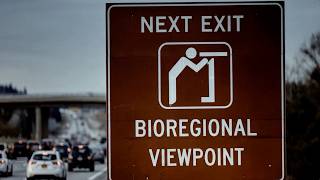
The Cascadia bioregion is a bioregion located near the Pacific Northwest as defined through the watersheds of the Columbia, Fraser, Snake, and Klamath rivers, as defined through the geology of the region. It extends for more than 2,500 miles (4,000 kilometres) from the Copper River in Southern Alaska, to Cape Mendocino, approximately 200 miles (300 kilometres) north of San Francisco, and east as far as the Yellowstone Caldera and continental divide and contains 75 distinct ecoregions.
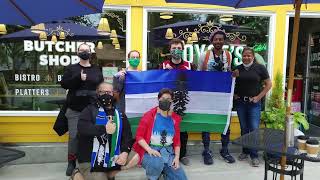
The Cascadia Bioregion encompasses all of the state of Washington, all but the southeastern corner of Idaho, and portions of Oregon, California, Nevada, Utah, Wyoming, Montana, Alaska, Yukon, and British Columbia. Bioregions are geographically based areas defined by land or soil composition, watershed, climate, flora, and fauna. The Cascadia Bioregion claims the entire watershed of the Columbia River (as far as the Continental Divide), the Fraser River, as well as the Cascade Range from Northern California well into Canada. It's also considered to include the associated ocean, the Cascadia Inner Sea, and seas and their ecosystems out to the continental slope running down the entirety of the Cascadia subduction zone to the Cape Mendocino Fracture Zone. The delineation of a bioregion has environmental stewardship as its primary goal, with the belief that political boundaries should match ecological and cultural boundaries.
The area from Vancouver, B.C. down to Portland, Oregon has been termed the Cascadia Megaregion, a megaregion defined by the U.S. and Canadian governments, especially along the "Cascadia Corridor". Megaregions are defined as areas where "boundaries begin to blur, creating a new scale of geography now known as the megaregion. These areas have interlocking economic systems, shared natural resources, and ecosystems, and common transportation systems link these population centers together. This area contains 17% of Cascadian land mass, but more than 80% of the Cascadian population. The Canada–US border is diminishing in the face of further economic, political and cultural integration with such programs as the enhanced drivers license program – which can be used to get across the Canada–US border between Washington and British Columbia.
Bioregional mapping is a powerful tool to increase understanding, change the story and influence policy. A good bioregional map shows layers of geology, flora, fauna, and inhabitation over time. All the interdisciplinary content that is integrated in this kind of map makes it a great communication tool to illustrate an ecological approach. One of the best examples of a richly communicative bioregional map is David McClosky's new map of Cascadia. W


This is the How-To guide for Locally Delicious. Please contact us the authors/editors of Locally Delicious: Recipes and Resources for Eating on the North Coast at info@locally-delicious.org for a more thorough discussion of our process, struggles, and recommendations for putting together this type of collaborative community project.
see also: Bioregional cookbook, Locally Delicious - The book
The bioregionalist perspective opposes a homogeneous economy and consumer culture with its lack of stewardship towards the environment. This perspective seeks to:
According to Peter Berg, bioregionalism is proactive, and is based on forming a harmony between human culture and the natural environment, rather than being protest-based like the original environmental movement. Also, while classical environmentalists saw human industry as the enemy of nature and nature as a victim needing to be saved; bioregionalists see humanity and its culture as a part of nature, focusing on building a positive, sustainable relationship with both the sociological and ecological environments, rather than a focus on preserving and segregating the wilderness from the world of humanity. W
Bioregionalism is a philosophy that suggests that political, cultural, and economic systems are more sustainable and fair if they are organized around naturally defined areas called bioregions (similar to ecoregions). Bioregions are defined through physical and environmental features, including watershed boundaries and soil and terrain characteristics. Bioregionalism stresses that the determination of a bioregion is also a cultural phenomenon, and emphasizes local populations, knowledge, and solutions.
Bioregionalism is a concept that goes beyond national boundaries—an example is the concept of Cascadia, a region that is sometimes considered to consist of most of Oregon and Washington, the Alaska Panhandle, the far north of California and the West Coast of Canada, sometimes also including some or all of Idaho and western Montana. Another example of a bioregion, which does not cross national boundaries, but does overlap state lines, is the Ozarks, a bioregion also referred to as the Ozarks Plateau, which consists of southern Missouri, northwest Arkansas, the northeast corner of Oklahoma, southeast corner of Kansas.
Bioregions are not synonymous with ecoregions as defined by organizations such as the World Wildlife Fund, One Earth, or the Commission for Environmental Cooperation; the latter are scientifically based and focused on ecology. Bioregions, by contrast, are watershed focused, factoring in humans and informed by ecology, geology, and biology. In this way, bioregionalism is effectively kincentric ecology with a focus on bioregions.
See also: Arts and culture, Community currencies activism, Ethical consumerism, Food activism, Local food, Food Sovereignty, Free stuff, Getting to know your locality, Getting to know your region, Reduce, reuse, repair and recycle, Resilient communities, Sharing, Community energy, Towards sustainable economies, Urban sustainability, Community land trust, Types of resources
local information and news can be found, or shared, via our many location pages
External links
| License | CC-BY-SA-4.0 |
|---|---|
| Cite as | Philralph (2023–2026). "Bioregionalism". Appropedia. Retrieved October 1, 2026. |