Download these pages as a PDF so you can print them or read them offline.
Booklet
Download these pages as a PDF that you can print, fold and staple into a booklet.
Materials
4 1.5m 28ga twisted pair
1 25cm 18ga speaker wire
1 15cm 18ga speaker wire
1 5.5mm x 2.1mm female barrel connector
3 Snap action limit switch
4 NEMA17 motor
1 Assembled hot end
1 4cm x 4cm fan
1.5mm heat shrink tubing
3mm heat shrink tubing
Tools
Soldering pen, solder and paste flux
Damp sponge or cloth for cleaning soldering tip
Wire strippers
Scissors for cutting heat shrink tubing
Paper towel for cleaning flux
Recommended - Third hand
Note
Tinning is the practice of wetting a conducting surface with solder. In this context, it is the wetting of the exposed conductors, which is recommended as loose strands can inadvertently cause short circuits and are inherently more difficult to control than a single cohesive unit.
Procedures
Tinning Conductor
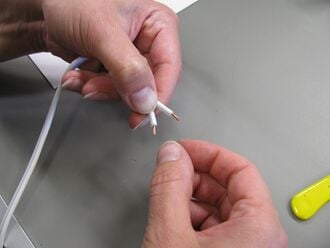
Stripped conductor twisting. After stripping a small amount of insulation from the end of the conductor, twist the strands together and dip into solder flux, applying a light coating of flux to the bare metal.
Solder the prepared strands together.
Clean excess flux from conductors.
Butt Solder Joints
A butt joint connects two conductors together, such as the fan wires that are soldered to a length of twisted pair. A "third hand" (either literal or the tool) greatly facilitates butt joining. An alternative to soldering butt joints is using a butt connector designed to be crimped in place.
Tin the conductors per instructions above.
Place adequate lengths of proper diameter heat shrink tubing over one of the conductors and push it away from the solder joint so it doesn't shrink during soldering.
Align the tinned conductors such that the two are parallel and touching.
Solder the joint, remove the soldering tip, then blow on the joint to rapidly solidify the solder.
Clean excess flux from conductors.
Slide the heat shrink tubing over the joint and overlap both insulators on either side of the joint. Shrink the tube in place with the soldering iron (a hot air gun can also be used).
Soldering Twisted Pair to Limit Switches
The limit switches have three terminals, one is common, one normally open, one normally closed. The controller firmware by default expects normally closed, which requires the conductors be soldered to the outermost two terminals, leaving the center terminal alone. Again, a "third hand" is helpful.
Strip and tin both ends of three each 1.5m length of 24ga twisted pair. Use three different colored pairs, one unique color for each limit switch.
Melt a small solder puddle on the two outermost terminals of the limit switch.
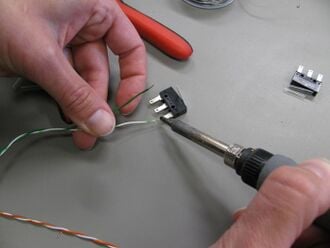
Soldering limit switch. Solder the conductors to the terminals at the puddles of solder. Blow on the joints to rapidly solidify the solder.
Clean excess flux from conductors.
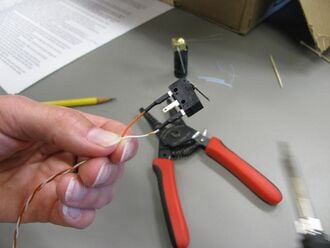
Optinal: Heat shrink tubing on limit switch. OPTIONAL: Slide the heat shrink tubing over the terminal and shrink in place.
Solder Extension to Fan Wires
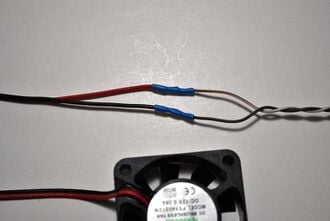
Solder extension to fan wires. Strip and tin both ends of a 1.5m length of 24ga twisted pair.
If the 40mm fan has a header on the wires, snip it off with wire cutters. Strip and tin the fan wires.
Cut a pair of small heat shrink tubes and slide one on each of the fan wires.
Keeping the heat shrink tube away from the joint, butt solder the twisted pair to the fan wires.
Clean excess flux from conductors.
Move the heat shrink tubing over the solder joint and shrink in place with the soldering pen.
Solder Power Cable to Barrel Connector
NOTE: Not needed as of 2019 with introduction of Athena Board
The positive terminal on the barrel connector is marked. Strip and tin both ends of a 15cm (6 inch) length of 18ga speaker wire or lamp cord.
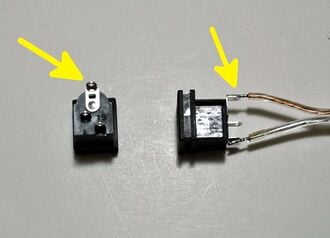
Melt a small pad of solder on the positive and negative terminals of the barrel connector. Use a continuity tester or DVM to insure the correct terminals are soldered. The positive lead will be soldered to the pin, ground to the outside contact. The third contact is generally not used - it is a switch that changes state when the barrel is inserted.
Solder the tinned ends of the speaker wire or lamp cord to the pads making note of which conductor is soldered to the positive terminal.
Clean excess flux from conductors.
Mark the positive conductor on the other end.
Tin Power Interconnect
A short length of 18ga speaker wire or lamp cord is used to connect power from the Melzi-Beaglebone Black bridge board:
Strip and tin both ends of a 10cm (4") long piece of 18ga speaker wire or lamp cord.
Clean excess flux from conductors.
Strip and Tin Motor Wires
If the motor wires come with a header attached, snip it off with wire cutters.
Three of the motors should have their wires shortened to 35cm. One motor (for the extruder drive) must have wires at least 75cm long.