The Vertical Garden is a unique indoor/outdoor modular planter with multiple levels of vertically spaced pots/planters. Its superior vertical design saves space and water. With a flow through irrigation system, when you water the top plants it will water all the lower pots, with no waste of water.
You can create different size racks to fit your garden needs. It can be tall with five levels of plants for a larger garden, or it can be built lower to the ground and longer if one so desires. With the Vertical Garden you use vertical space to stack, hang and plant, saving your horizontal space.
Using the vertical space instead of horizontal space is an important feature for those short of planting area in condos, or apartments with small balconies.
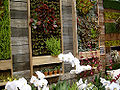
As you can see from the photos below, there are many variations of 'vertical gardens', also known as 'green walls.' From small simplistic gardens to large structures with aesthetic design; vertical gardens are adaptable to whomever wants to create them and designed for their own individual goals.
Small wall mounted garden for outside decoration.
Large mounted garden on outside of building.
Medium green wall on inside of building for decoration.
Small board mounted garden for display and educational purposes.
I plan on creating a solar powered vertical vegetable garden. My project will be a version that follows the concept shown in the photo below; where there is a self watering pump that is powered by the sun. I will be creating a low cost and mostly recycled version of the photo below, but also attempt to have a high density crop yield with a solar water pump through a different design. I hope to produce a high density vegetable garden that those on budgets can implement themselves with local resources.
Harvested crops must sustain at least 2 people's consumption for 1 week
9
Size
Must fit into a floor space of 3'x5'
8
Maintainability
No more than 1 human hour per week
8
Transportability
Must be collapsable to a reasonable transportable size.
5
Surface Area Saved
Assuming that 1 plant requires 1 cubic foot of area, the surface area saved by planting vertically versus horizontally per plant would be at least 0.5 cubic feet (50%)
The Delphi Decision Matrix for Alternative Solutions is a way in which someone can eliminate a bias towards a particular project choice. Maybe the idea of something changing around is cool, but is it the best choice to meet your project criteria? This matrix helps to efficiently decide if a project will meet your criterial standards and be the best choice over all.
The Perfect Garden Alternative is to the standards of the photo from the' Proposed Idea for Project' section. The framing will be a strong metal such as aluminum, the solar panel will be much larger for a strong pump, and the crop yield will greater due to the larger area over all that it would be built for. Although, these additions will increase the cost and size of the operation.
The Green Thumb Alternative will be a middle of the road scenario between the photo from the 'Proposed Idea for Project' section and the cheaper version I have in mind. The frame will be built from PVC piping or reused materials. With a smaller pump we will save on cost but the general size and garden yield will be smaller. With this option the cost and size should be sufficient.
The Veggie Starter Alterative is more like a sustainable version of the photo from 'Proposed Idea for Project' section. The size is small and the yield will also be small. Due to the small structure we would not be able to grow large vegetable such as tomatoes. Although, the cost is very low and the size and maintenance will be minimal.
How Pumps Work- A photovoltaic solar panel is placed in the sun and collects the sun's energy. The panel then converts the collected solar energy into electrical energy for use. The panel is attached to a battery where the electrical energy charges the battery and the energy is stored until future use. The battery is connected to a pump. When the pump is switched on, the pump will draw the stored energy from the battery house in order to run itself. The pump will lift the water from the reservoir to the directed location. In our case, the water will be lifted up to a planter above.
Each pump is chosen specifically for each individual project. If the garden is tall it will need more 'water uplift' than a shorter garden. This means it will be more expensive because it will require a larger solar panel and battery.
You will need to measure the height of your garden in order to know around what size pump will be needed for that water uplift height.
Each pump is manufactured differently at varying sizes. This causes differences in what size pipe will be needed to attach to the pump.
What is Pipe Friction and Head Loss? The friction created from water running over a surface will cause the water to slow down. With water flowing vertically through a pipe, the friction will cause the water lift to not go as high versus if there was no friction at all. This height difference will be the amount of water lift that will be lost due to the friction caused by the pipe (aka. pipe friction). This height difference number is referred to as 'Head Loss'.
This website allows you to put in your system's measurements and tell you what your loss will be.
The height of my tallest planter from the bottom of the water reservoir is 50 inches. I need my water lift height to be at least that height in order to reach the top plants.
IMPORTANT: It is important to take into account the friction caused by the tubing. This will make the water lift less which requires a larger pump than you measured for.
PUMP Specifications:
8 Watts Solar Power Water Pump
Solar Module-Amorphour Solar Panel 2 pcs 4W 18V
DC Brushless Pump Operation Voltage - DC 12- 20V
Water lift (Jet Height) 2.5 Meter (8.13 ft.)
Large Solar Panel Dimension: 16 inches x 14 inches per panel
Water flow Capacity: 800 L / H (211 G/H)
Cable Length of DC Pump: approximate 3 meters (9.8 ft.)
Price=$99.99 (I found a great deal on EBay.com)
My Head Loss Calculations
Pipe Length=5'
Material Coefficient=130-150, I averaged to 140
Flow Rate (gal/min)=3.5237, I rounded to 3.5
Diameter=1/2" ID
Results
Head Loss (ft H2O / 100 ft pipe): 33.139
Head Loss (psi / 100 ft pipe): 14.3
Head Loss (ft H2O): 1.657
Head Loss (psi): 0.7
Velocity (ft/s): 5.72
So what do these numbers mean?
My water lift height will loose 1.6 feet off of the original 8.13 feet due to the friction inside the tubing. This means I will get a water lift height of 6.5 feet. I have enough water lift to reach my top plants. Having the extra foot of water lift above what I need allows for the extra friction that will be created within the pipe when I add adapters to the main water line.
Follow manufacture's instructions on how to properly set up your individual solar pump.
Once the pump is set-up, follow these steps to test:
Allow the solar panels to charge the battery in full sun for the whole day. This guarantees full battery charge.
Attach vinyl tubing over the outflow point on the pump and place the pump in water reservoir.
Hold the vinyl tubing vertical next to your garden and turn the pump on full.
Check to see that the water uplift height is high enough to reach the top of your garden; with about a foot extra above the top.
If it does reach the top, you now know that you do have enough uplift to water your garden. If it does not reach the top, you will need to get a larger pump to supply you with more water uplift.
Read the manufacture's product description to give you and idea of how much water uplift that particular pump will provide you with.
All instructions are how to build the system I made specifically. Each design and alteration will require their own construction needs. Feel free to follow along or build your own using these ideas!
There should be a clear idea of what you would like to accomplish with your garden. Original designs are usually inadequate and alterations are necessary. Below are the diagrams of my design changes from original to final design
-Design 1 Problems: The irrigation system does not allow for equal watering. The plants on the top level will have the only water input to the system and will get over-saturated. The lower levels will get less water because the previous planters would take it all. It also does not allow for equal fertilization. The bottom plants will get too much fertilizer because of the water draining through the previously fertilized plants and will accumulate when it reaches the bottom. Having and open reservoir allows too much debris to enter the irrigation system and clog it.
-Design 2 Problems: The center bottle planters were not getting equal watering. Pressure from the main line only reached the first bottle and slightly to the second planter and none to the last two. The top and bottom gutters were either draining too fast or getting over-flowed from too much water. The bottom gutter received too much water from the inflow of the top gutter and the center bottle planters.
-Design 3 Final: Adding over-flow drainage to both gutters fixed any over watering problems. The manifold added to the center bottle planters creates equal water distribution for bottles. Draining the center planters to the reservoir instead of the bottom gutter helped with over watering and overflowing the bottom gutter.
Since I was donated a pre-existing metal frame with four shelves, there was little building for this step. If you are building your own frame, please find construction information elsewhere.
Cut off bottom shelf to make room for reservoir. (refer to Fig. 3)
Cut off center metal bar on each shelf to make room for planters.
Cut off bottom connector bar to install reservoir platform.
Measure and cut platform board to fit onto bottom frame.
Measure bolt spacing for connecting bolts.
Drill bolts through wood reservoir platform and into metal frame to connect and stabilize. (refer to Fig. 5)
Tools Used: Dremel Rotary Tool, Electric Drill, Circular Saw
Due to the frame being metal, there was no testing involved. If you built your own frame you would need to test the strength of the frame so that it is strong enough to support the plants weight.
Testing the frame involves checking for any loose areas so that the frame fits secure and strong, and checking that the weight of the panel is not too heavy so that it will not topple over the garden.
Check the stability of them on the frame, the weight distribution of planters on the frame, that planters are level/balanced for equal water flow, and check that the inflow and outflow holes will allow for easy water flow through the planters.
Gutter Planter Irrigation System (refer to Fig. 18 yellow system)
Attach the vinyl tubing from the water pump's output to the top gutter's end-cap hose-barb attachment. (refer to Fig. 15)
Attach the vinyl tubing from the top gutter's drainage hose-barb attachment to the bottom gutter's end-cap hose-barb attachment.
Attach the vinyl tubing from the bottom gutter's drainage hose-barb attachment and lead the end into the reservoir.
2L Bottle Planter Irrigation System (refer to Fig. 18 purple system)
On the main water line from the pump to the top gutter, cut the vinyl tubing at the height a few inches above the 2L bottle planters.
Install a 'tee-hose-barb' adapter to the main line with the 90 degree offshoot pointing inward towards the planters.
Attach the vinyl tubing to the 'tee-hose-barb' offshoot.
Install a 90 degree 'elbow-hose-barb' to the end of the vinyl tubing.
Attach a short piece of vinyl tubing to the 'elbow' attachment pointing down.
Install a 'hose-barb to pipe-thread' adapter at the end of the hanging vinyl tubing.
Screw on the manifold to the threaded end of the adapter. (refer to Fig. 20)
Attach poly tubing to each manifold emitter and lead them into the planters. ~NOTE: You should already have the beginning drainage tubing attached to the planter bottle caps from the 'Building Planter's section. If you missed this step, refer back to that section and Fig.13 (#Building Planters)
With the drainage tubing connected to the bottle caps, take the two left bottles and attach the drainage tubes with a 'tee-hose-barb' adapter. Do the same to the two right bottles drainage tubes.
Attach vinyl tubing to the two 'tee-hose-barb' adapters and connect those drainage tubes with a final 'tee-hose-barb' adapter with the offshoot facing down. (refer to Fig. 20)
Lead the now single planter drainage tubing down into the reservoir. (refer to Fig. 18 and Fig. 19)
-Consistency should be that when you make a ball of soil in your fist, the soil is dense and moist; and when you open your fist, the soil will crumble in large chunks and turn soft again.
Gutter Planter Planting (refer to Fig. 23)
Line the gutter with wire mesh so that it goes up each side and covers all tubing openings. This prevents large debris getting into the irrigation system.
Take green strawberry baskets and line them with wire mesh to hold in the soil.
Fill with mixed soil.
Plant vegetable starts or seeds in baskets; whichever the plant requires.
Set baskets in gutter planter.
2L Bottle Planter Planting (refer to Fig. 24)
Place a square of wire mesh at bottom of bottle so that it covers the bottle cap where drainage occurs.
Fill bottom 1/4-1/2 of bottle with medium and small rocks. (Fill height depends on how deep your plant's roots require.)
Fill rest of bottle with mixed soil, leaving at least 1 inch of space from the top empty.
Plant vegetable stars or seeds in bottles; whichever the plant requires.
Once the planters have their soil and planter boxes installed, turn on the water pump.
Check for the water being drawn up into the soil to water plants. Also, check if the soil is staying together and not just being broken apart and washed away by the flowing water which could clog the irrigation system pipes.
There are many options for fertilizers. I found through my research that bat guano would work best for my size operation. It takes little guano sprinkled over the plant to get the nutrients. It is also able to be mixed with water as a type of nutrient to water the plants by hand if so desired. Also, the pH level of bat guano is fairly neutral, 6.3 to 6.8; and this allows for it to fertilize all types of vegetables.
It would be best to decide which fertilizer you would like to use depending on the maintenance you are willing to put into your garden. Your plant types also have a 'happy' pH level that they like to grow in, and that will also take a role in which fertilizer you will choose.
Research on your own for this step to get the best personalized success for your garden.
Create a spread of your vegetables in a green house tray. One row has one of each vegetable in a line. (refer to Fig. 23)
Keep one row as the control and only use water.
On the other rows, pick which fertilizers you are interested in and fertilize each row with one option.
Watch the plants for two weeks, watering as needed and fertilizing as instructed to by individual fertilizers.
By the end, you should see which row of vegetables grew healthier, fuller, and faster by the end of your test run. This is the fertilizer that will best suit your overall garden vegetables.
- I found that bat guano worked well for all plants because it was a fairly neutral pH so the plants did not get too acidic or basic in their soil.
-Water will be coming from the Mad River in Blue Lake, Ca to my apartment in Arcata, Ca for tap water.
-Cost: (Basic water service charge is $9.00) + (Personal usage range of 501-1500 cubic feet which costs and additional $1.55) = Total cost is $10.55
-With the additional use of water supplied to the garden, I will not exceed the personal usage range of 501-1500. Therefore my normal water bill will not increase.
-Externalities include: the cost of pumping the water from the river to my location, environmental damage from the pump, removing water for fish to live, gas used to power the pump, transportation of gas from oil fields in the middle east to the USA.
Sewer:
-If I was to dump water down my home drain, the Arcata Wastewater Treatment Plant will be handling the extra nutrients from my added fertilizer.
-If I was to dump water outside, the water will drain back into the water column and the fertilizer will provide extra nutrients to the plants around that area.
-Externalities include: energy to treat the fertilizer at the plant
Electrical:
-My garden is all solar powered. There is no outside electrical source so there will not be any additional costs.
-Externalities include: the environmental degradation and energy required to manufacture the solar panels.
Maintenance:
-Weekly check-up includes:
Weeding plants
Change and/or re-fill water in reservoir
Check for and clean out any debris caught in irrigation system
Fertilize if needed
Harvest vegetables if needed
General gardening such as pruning or transplanting, as needed
No external electricity dependance, so you can put your garden anywhere.
Self-watering allows for less maintenance and there are no worries of forgetting to water.
Easy to clean, replace parts, and transportable.
You are not hurting your back by gardening on the ground.
Each plant has it's own container making transplanting easy.
Each planter is removable so changing the plant layout is simple.
Compact design makes this garden perfect for small space gardening.
Bad
1. Does not have enough battery power to self-water if there is not enough sun light.
Although, in Arcata, Ca, it is assumed that if the sun is not out that it is raining; so the plants will be watered by the rain.
2. The gutter planters are a little small and plants may need to be transplanted to larger pots; but the liter bottles work perfectly to allow full maturity.
Sargent, S, M Ritenour, and J Brecht. "Welcome to Glades Crop Care Website." Welcome to Glades Crop Care Website. Version HS719. Institute of Food and Agricultural Sciences, University of Florida, n.d. Web. 11 Feb. 2010. <http://www.gladescropcare.com>.
Splittstoesser, Walter E.. Vegetable Growing Handbook: Organic and Traditional Methods. 3rd ed. New York: Van Nostrand Reinhold, 1990. Print.
Some Psychological Benefits of Gardening by Rachel Kaplan
If you would like to read more about benefits of gardening, you can find the journal on Microfilm at the Cal Poly Humboldt Library. Box 1342, V.1-6, Kaplan.
Gardening is an essential component in rest and recovery. Just as art, poetry, and other leisure activities are important to us, the natural environment, such as gardening, is an excellent relief option.
It requires a constant commitment rather than a casual experience with the outdoor environment. This helps to retain focus for rest and recovery rather than focusing on other daily stresses.
We have a basic survival instinct to harvest and provide our own food. This benefits our natural need to be connected to the Earth.
It is a close-at-hand form of leisure activity.
It provides a connection to where our food came from.
Your garden should not have to compete for the sun due to shade by other plants and buildings.
When planting in containers, make sure the vegetables have enough root space to grow healthy. Do not plant deep rooted vegetables in too shallow of a pot.
Do research for each plant you wish to grow so that you know the basics of caring for that plant; including pruning, space and water needs.
Plants growing in containers should not be crowded, thus limit the number of plants per pot.
Water with cool water, not hot.
Container plants require frequent watering and fertilization.
Reduce insect problems by not placing two of the same cultivated type next to one another. Spacing them out is better.
Spring, summer, and fall crops grow at different rates and require different attention. Do research to further your knowledge on what the seasonal change does to your garden area.
A planting medium is a surrounding environment in which something functions and thrives, i.e. your plants. The substance in which you plant your vegetables will be the medium in which nutrients and water will enter your plants root system. It also provides a supporting base structure for the plant hold on to.
A condition in which water is removed from the soil so slowly that the soil is saturated periodically during the growing season or remains wet for long periods greater than 7 days.
To get more drainage, create a gravel layer below the garden bed to allow water to escape.
Alkalinity is the characteristic of soils with a pH level that is greater than 7, which is suitable for plants that thrive in a "sweet" (alkaline) soil, as opposed to a "sour" or acid soil.
To make your soil more alkaline (raise the pH) add lime.
Handling, Cooling and Sanitation Techniques for Maintaining Postharvest Quality from the Institute of Food and Agricultural Sciences, University of Florida
Addition of an approved sanitizer to the water, such as sodium hypochlorite, calcium hypochlorite or liquid chlorine, to prevent the accumulation of pathogens.
-The main advantages to using chlorine are that it is effective at killing a broad range of pathogens and that it is relatively inexpensive. It also leaves very little residue or film on surfaces.
-If there is no use of pesticides, sanitation is still necessary for the consumers own health.
I would like to build small green house covers for the planters. This way I can protect the plants from weather damage during a storm and also grow starts in the garden.
After tasting all the fruits of my labor... I would recommend to NOT grow celery. They take too much water than my garden could supply, and a lot more space for roots because they grew down into the tubing.
The garden has gotten bigger than ever imagined. The bottom tomato plants are taller than the top plants! I have NOT replanted any of them. They are that big in small strawberry baskets!
I have harvested so many beautifully large and ripe strawberries.
All tomatos are beginning to bloom and ripen.
My first zucchini from the garden will be ready to pick mid August.
The garden is a SUCCESS! I am excited to start another garden for next growing season.






 Small wall mounted garden for outside decoration.
 Large mounted garden on outside of building.
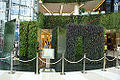 Medium green wall on inside of building for decoration.
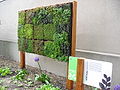 Small board mounted garden for display and educational purposes.
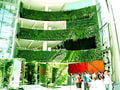 Large green wall on inside of building.
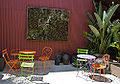 Small wall mounted garden for outside decoration.


 Design 1
 Design 2
 Design 3


 Fig.1-Donated metal frame from Shafer's Ace Hardware Store.
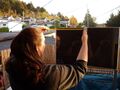 Fig.2-Measuring solar panels to mount to the metal frame.

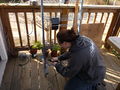 Fig.3-Using a Dremel Rotary Tool to saw off metal shelves for reservoir space.
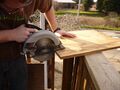 Fig.4-Cutting a 3/4 inch plywood to make a platform for the reservoir to sit on.
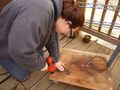 Fig.5-Attaching platform to metal frame.
 Fig.6-Reservoir is now mounted to bottom of the garden frame.


 Fig.7-Two separate 4W solar panels ready to mount into custom frame.
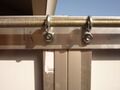 Fig.8-Top of frame. Bolts to hold aluminum together and eye-bolts to hang all-thread from.
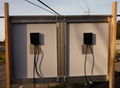 Fig.9-Now one unit, the panels are mounted to top of metal frame from extended wood arms.
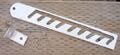 Fig.10-Home-made 'angle-prop' from extra aluminum.
 Fig.11-Now we can change the angle of the PV panels for best solar accumulation.


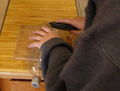 Fig.12-Cutting off the bottom of 2L soda bottles for planters.
 Fig.13-Bottle cap drainage for 2L soda bottles.
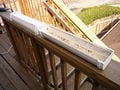 Fig.14-Gutter has been cut and ends placed on. Ready to mount.
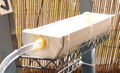 Fig.15-Connected tubing to Hose Barb, sealed with plastic epoxy.
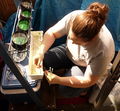 Fig.16-Attaching gutter planters to metal frame.
 Fig.17-Garden with no irrigation system or plants.


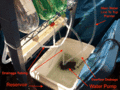 Fig.19-Diagram of irrigation system.
 Fig.20-Diagram of irrigation system.
 Fig.21-Final mounted irrigation system. Back.
 Fig.22-Final mounted irrigation system. Front.


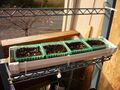 Fig.23-Installed baskets with soil in gutter planters
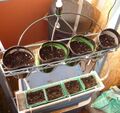 Fig.24-Soil in 2L bottle planters
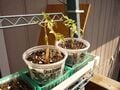 Fig.25-Tomato plants prepared for installation
 Fig.26-Finished project!


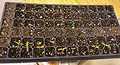 Fig.27-Vegetable sprouts after 1.5 weeks; treated with bat guano
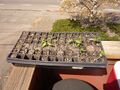 Fig.28-Vegetable sprouts after 3 weeks; almost ready for planting


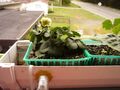 Garden's first bloom, strawberry! 5-16-10
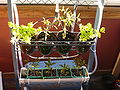 The plants are doing great! 5-25-10
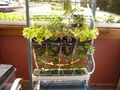 Even bigger! 6-7-10
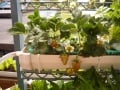 Strawberries almost ripe! 6-25-10
 Huge tomato plants! 6-25-10
 Thick celery and deep roots. 6-25-10
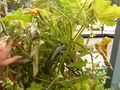 First zucchini! 8-11-10
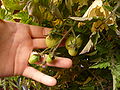 Yellow pear tomatos. 8-11-10
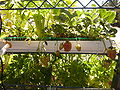 So many strawberries! 8-11-10
 The tomato's on the bottom are dominating the project. But they are all very healthy.


